11 Small Kitchen Organizers That Save Counter Space (Tested and Honest)

As an Amazon Associate, I earn from qualifying purchases, at no extra cost to you.
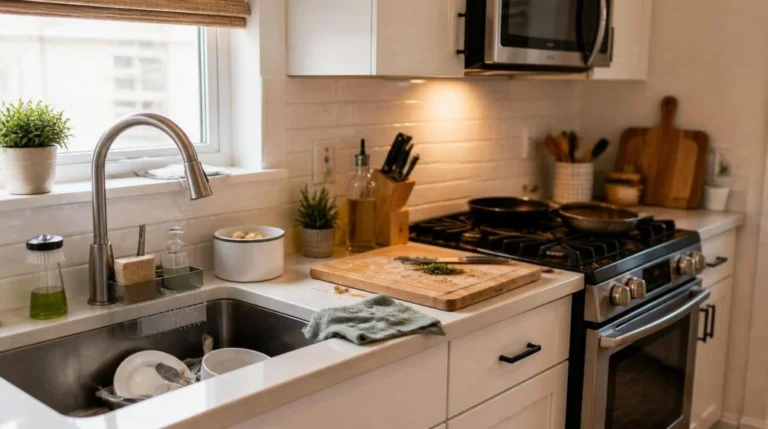
There’s a specific frustration that hits when you’re prepping dinner and there’s nowhere to put the cutting board. The toaster, the coffee maker, the knife block, the fruit bowl – all of it taking up counter space that should be yours.
My solution for a long time was to just stack things more carefully. That’s not a solution.
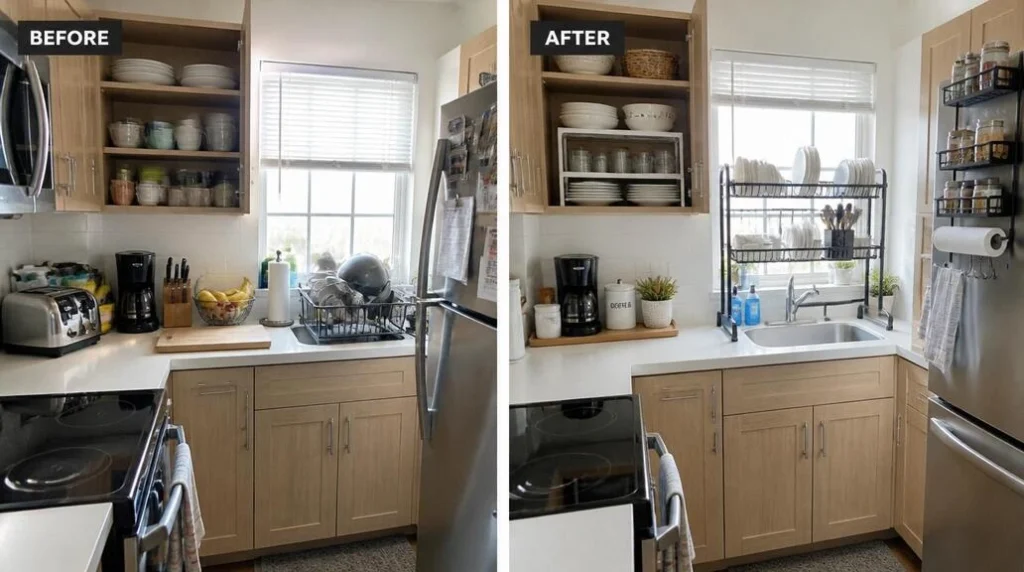
What actually helped was finding organizers that didn’t rearrange the clutter, they moved it off the counter entirely. Not every “space saver” does that. Some just add more stuff. So, this list covers only the small kitchen organizers that made a real, visible difference in my kitchen, with honest notes on what works, what doesn’t, and what to look for before you buy.
Before You Buy Anything
Measure your counter depth and the vertical space between your counter and cabinets before buying anything. Organizers often list dimensions that sound compact until they’re sitting in your kitchen taking up more room than expected.
Also worth knowing: there’s a difference between organizing counter items and clearing counter space. A pretty jar set for your spatulas is organization. A wall-mounted rail that gets them off the surface entirely is space recovery. This list focuses on the second category.
One last thing, it’s easy to overbuy organizers. In small kitchens, that can sometimes create more clutter instead of less. Start with one or two changes, see how they work, then build from there.
What to measure before buying
Take a quick measurement before ordering anything:
- Sink width and faucet height
- Drawer width and depth
- Cabinet shelf height
- Narrow gap width beside the fridge or cabinets
Those few checks help prevent the most common organizer mistake: buying something that sounds right on paper but does not really fit your kitchen.
How I chose these organizers
This list focuses on organizers that solve real small-kitchen problems, not products that just look tidy in photos. I prioritized picks that clear workspace, use overlooked storage better, and make everyday items easier to manage.
Top 5 Quick Wins
| Organizer | Best for | Main benefit | Watch for |
|---|---|---|---|
| Over-the-Sink Dish Drying Rack | Crowded sink area | Frees the counter beside the sink | Check sink width and faucet height |
| Magnetic Fridge-Side Organizer | Spices, wraps, paper towels | Uses overlooked vertical space | Make sure the magnets are strong |
| Slim Rolling Cart | Narrow gaps | Turns wasted space into storage | Measure the gap exactly |
| Expandable Drawer Organizer | Utensil clutter | Gets tools off the counter | Check drawer width and depth |
| Cabinet Shelf Riser | Stacked plates, bowls, and mugs | Doubles cabinet storage vertically | Measure interior cabinet height for clearance |
The full list: 11 smart organizers for small kitchens
1. Over-the-Sink Dish Drying Rack
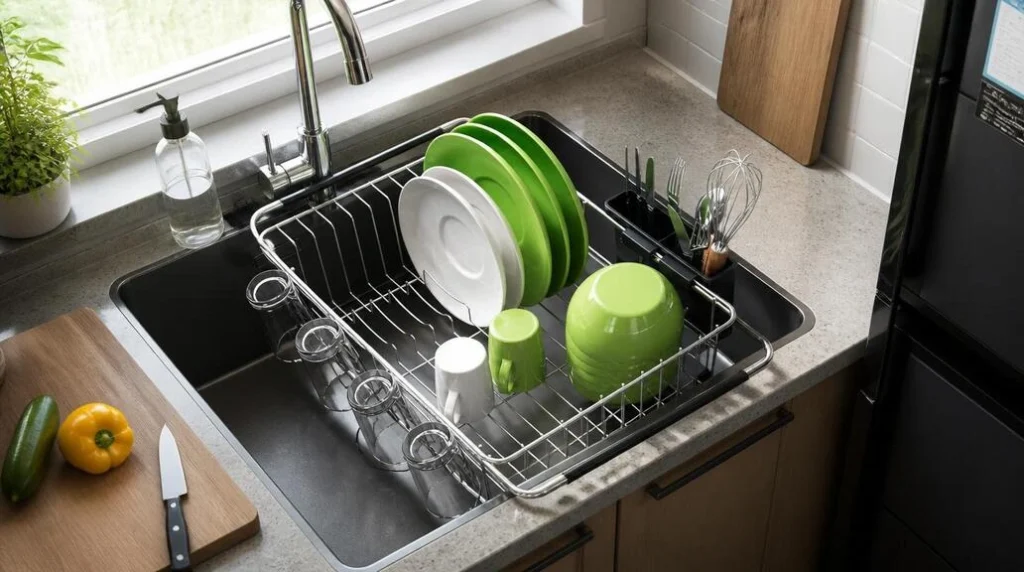
The space directly above your sink is some of the most underused real estate in a small kitchen. An over-the-sink rack turns that dead zone into a full drying station, keeping wet dishes, utensils, and even produce off the counter entirely. Mine cleared almost a full third of my main prep area the day I installed it. Look for one with adjustable arms to fit different sink widths, and make sure drainage directs water into the sink rather than pooling on the frame.
2. Magnetic Fridge-Side Organizer
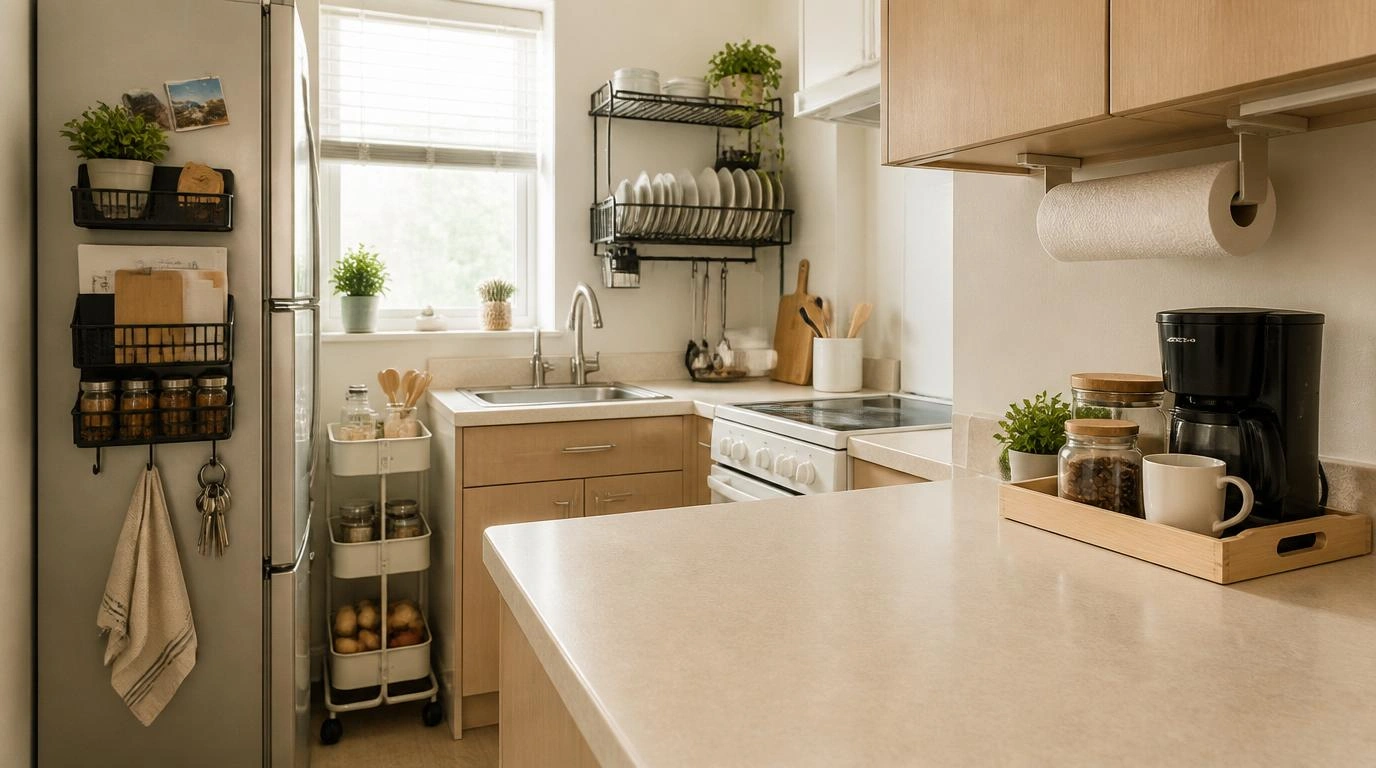
The side of your fridge is a blank wall you’re probably ignoring. Magnetic organizers stick directly to it and can hold spice jars, a knife strip, paper towels, or small tools depending on the set. It takes up zero counter space and zero cabinet space. Just confirm your fridge surface is magnetic before ordering, because not all are.
In my kitchen, this worked best for the things that used to hover around the stove, salt, pepper, foil, and paper towels. Once they moved to the fridge side, the counter looked noticeably calmer without feeling less functional.
3. Slim Rolling Cart
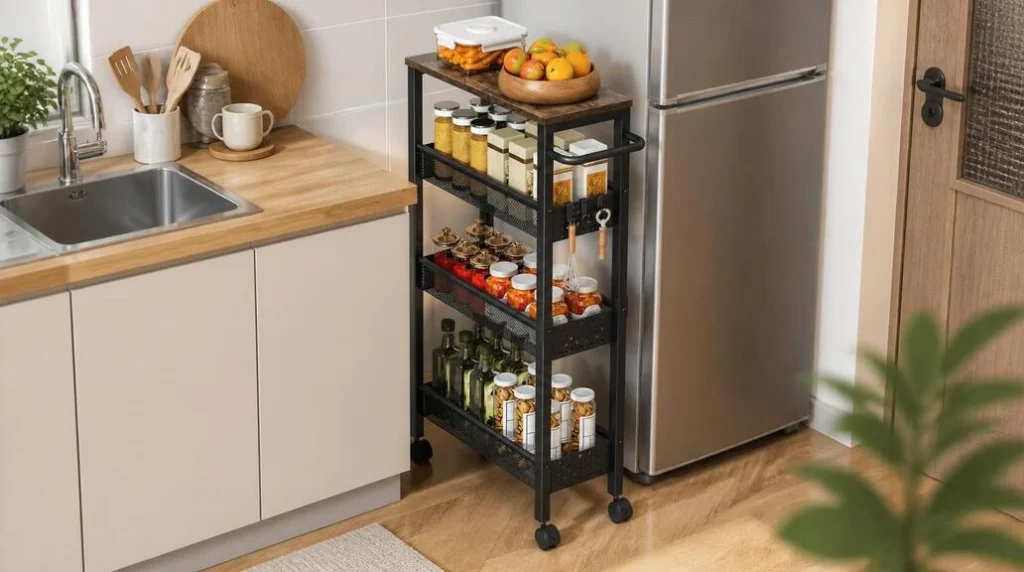
A rolling cart works especially well in the gap between the fridge and the wall, or between the counter and the stove. It adds vertical storage for oils, canned goods, or cleaning supplies and rolls out when you need it. I use mine for baking supplies I don’t reach for daily, which freed up a full cabinet shelf. The key detail to check is the width. Measure your gap first because “slim” varies a lot between brands.
4. Expandable Drawer Organizer
A messy utensil drawer is a small thing that slows you down every single day. An expandable organizer with adjustable dividers fixes that without requiring a new drawer or extra counter space. It works best when you actually edit what goes back in. If the drawer is stuffed before you organize it, the organizer won’t save it.
The biggest difference here was not the organizer itself, it was finally giving each tool a place. Once I stopped tossing everything into one drawer, I stopped leaving utensils out on the counter too.
5. Cabinet Shelf Riser
Cabinet shelves often waste more vertical space than people realize. A shelf riser adds a second level inside the cabinet, which makes everyday plates, bowls, or mugs easier to store and grab. I found this especially helpful in cabinets that felt full even though there was still empty space above everything. Just check the interior shelf height before buying so it fits with enough clearance.
6. Under-Sink Pull-Out Organizer
The cabinet under the sink is usually a chaotic pile of cleaning products and mystery items. A pull-out organizer with two tiers changes that by making everything visible and reachable without digging. Before I added one, I had no idea what was actually under there. Most designs work around the plumbing, but measure your interior cabinet dimensions and note where your pipes sit before ordering.
7. Turntable for Oils and Sauces
A lazy susan turntable keeps oils, vinegars, and sauces accessible without having to move six things to reach one. On the counter it tightens up a cluttered cooking zone. Inside a cabinet it prevents the usual situation where things get pushed to the back and forgotten. I keep mine inside a lower cabinet and it genuinely changed how I cook, everything is one spin away. Opt for one with a raised edge so bottles don’t slide off.
8. Under-Cabinet Paper Towel Holder
Moving your paper towel roll under the cabinet is one of the quickest counter space wins available. It mounts with screws or adhesive strips and keeps the roll accessible without it sitting on the counter. Adhesive versions are easier to install but work best on smooth, painted surfaces. If your cabinets have a textured finish, go with screws.
After moving mine, I noticed that corner became easier to wipe down and a lot less cluttered visually. It is a small change, but it feels bigger in daily use than it sounds on paper.
9. Stackable Pantry Bins
Open pantry shelves or deep cabinets become much more usable with stackable bins that let you categorize and pull out groups of items at once. Snacks in one, baking supplies in another, canned goods in a third. The stackable design means you use vertical space instead of spreading everything flat. Clear bins are worth it so you can see what’s inside without labeling everything.
What helped most was not buying a full set at once. I started with just a couple of bins for snacks and baking extras, and that made it much easier to see what type of storage I actually needed.
10. Under-Shelf Mug Hooks
If your mugs are sitting on the counter or taking up a full cabinet shelf, under-shelf hooks solve that cleanly. They clip onto the shelf above and hang mugs by the handle, freeing up an entire shelf for something else. I moved four mugs off the counter with a single set of hooks, and that shelf now holds my small appliances. Most fit standard shelf thicknesses but check the clip specs if your shelves are thick or have a lip on the edge.
11. Coffee Station Tray
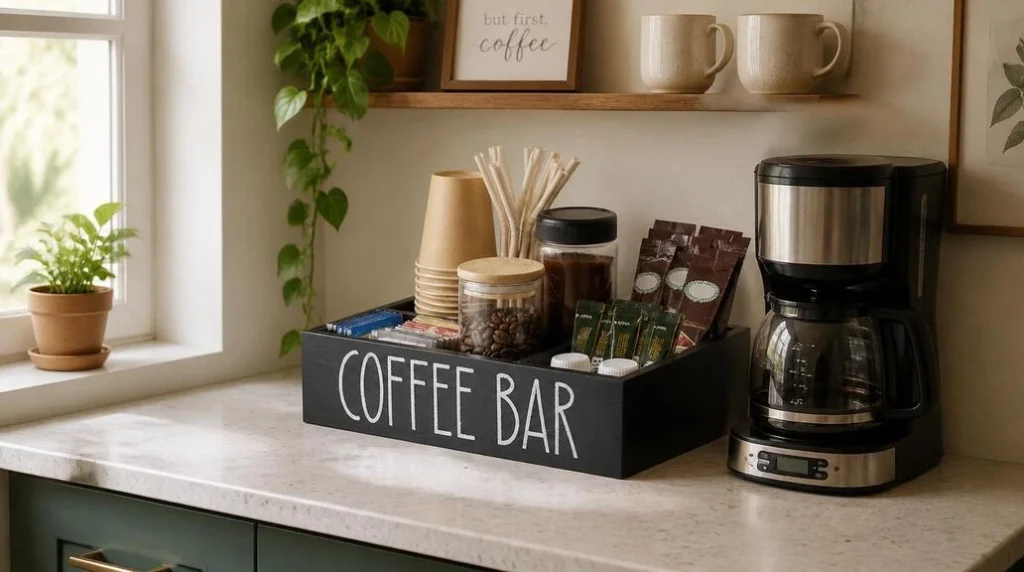
A tray doesn’t move anything off the counter, so it belongs at the end of this list. What it does is contain the coffee corner, so it reads as intentional rather than cluttered. Everything stays in one defined zone, the coffee maker, the mugs, the pods or beans, and the area around it stays clear. If your coffee setup is already on the counter and not going anywhere, a tray makes it look like a decision instead of an accident.
Which organizer should you buy first?
Start with the organizer that fixes the spot that frustrates you most.
- If dishes are taking over, start with the over-the-sink rack.
- If small items keep piling up near the stove, start with the magnetic organizer.
- If storage feels awkward, start with the rolling cart or shelf riser.
- If the clutter is mostly around your morning routine, start with the coffee tray or mug hooks.
What Didn’t Work as Well as Expected
In the interest of being honest, not everything I tried was a win.
The coffee station tray was the most underwhelming addition. It looks clean and intentional, but it didn’t actually recover any space. Everything that was on the counter before the tray is still on the counter after it. If reducing clutter is the goal, a tray reorganizes the problem rather than solving it, which is why it’s last on this list.
I also tried a countertop turntable before moving it inside a cabinet. On the counter it helped slightly, but it also became a landing spot for random items that had nothing to do with cooking. Inside a cabinet it works exactly as intended. The placement made all the difference.
The under-cabinet paper towel holder was a genuine improvement, but the first spot I chose was slightly too close to the stove. I ended up remounting it, which wasn’t difficult but was avoidable. Think about where your hands actually are while you’re cooking before you commit to a position.
None of these were bad products. They just needed the right placement or the right expectation. The best organizer is the one that fits how you actually cook, not how you imagine you cook.
A Simple Way to Think About Counter Space
Before buying anything, it helps to sort what’s currently on your counter into three rough categories.
Things that genuinely need to be there: used every single day, too heavy or awkward to move in and out repeatedly, or actively part of your cooking workflow. The coffee maker probably belongs here. The toaster, for a lot of people, does too.
Things that could move with the right solution: knife block (magnetic strip), spices (wall rack), dish rack (over-sink version), drying mat (just store it).
Things that shouldn’t be there at all: the mail, the random charger, the snack bag, the thing you set down three weeks ago. No organizer fixes this. That’s just clearing.
Most counter chaos falls into the second and third categories. The organizers in this list are tools for the second group. The third group just needs a decision.
If your counters are starting to feel under control and you want wiping down and dishes to feel easier too, you might like these 11 kitchen cleaning ideas that make cleanup faster. They focus on small habits and tools that cut actual cleanup time in a normal kitchen.
FAQ
What saves the most counter space in a small kitchen?
Usually an over-the-sink dish rack or a magnetic fridge-side organizer, because both use areas that often go ignored.
Are clear bins always better?
Not always. The right size and shape matter more than whether the bin is clear.
What should stay on the counter in a small kitchen?
Only items you use often enough to justify the space, such as a coffee setup, one daily-use appliance, or a small tray that keeps essentials contained.
Wrapping Up
Most small kitchens don’t need a renovation. They need two or three well-chosen organizers and an honest look at what’s actually taking up space and why.
Pick one item from this list, something that addresses your most specific frustration, whether it’s the dish rack, the knives, or the cabinet overflow. Try it for a few weeks. See what actually changes. Then go from there.
Small, deliberate changes tend to stick better than overhauling everything at once. At least that’s been true in my kitchen.